
The Bottle Ship Museum
Welcome to a collection of bottle ships and ship models in the heart of Ærøskøbing. Open from 27 June to 30 September 2026
The Bottle Ship Museum is open seasonally. We look forward to seeing you in 2027.
In the heart of Ærøskøbing
If you are in Ærøskøbing during the summer season and are curious about maritime cultural heritage craftsmanship, then Flaske-Peter’s collection of bottle ships and ship models is the perfect place to visit.
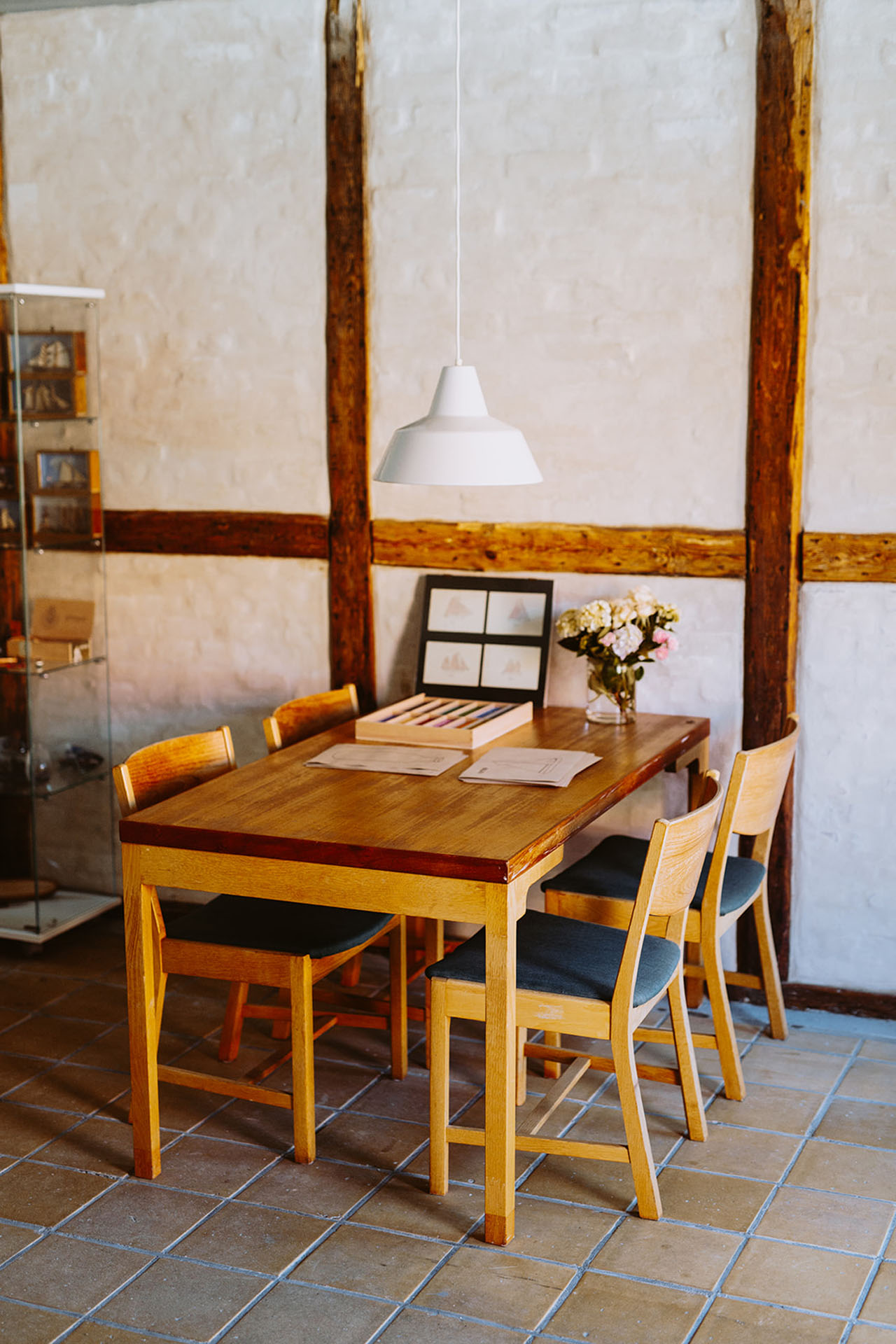
The collections are exhibited in Ærøskøbing’s former poorhouse and have been there since 1943. Bottle-Peter (1873–1960) built more than 1700 bottle ships and 50 large model ships.
Bottle-Peter’s Collection is open seasonally from 27 June – 30 September 2026.
Ships in bottles and display cases
Ships in bottles, display cases, and cigar boxes
Bottle-Peter was extremely productive and built over 1700 bottle ships, 50 ship models, and around 70 cigar boxes. On Smedegade you can explore hundreds of them.
All bottle ships are different, and each one bears witness to dexterity, skill, a sense for detail, and proportion. On average, Bottle-Peter spent 2½ days completing a bottle ship. He used a bottle, scissors, a pocketknife, a piece of wood, white thread, a needle, putty, paint, steel wire, and a homemade awl.
Ships in cigar boxes
In the collection, you can see bottles from Alaska, Singapore, Shanghai, and London, among others. There are small, large, thick, thin, round, and long-necked bottles. There are square whiskey bottles, greenish liqueur bottles, a Chinese beer bottle, and a Russian vodka bottle. There are bottles shaped like a clown, a parrot, and a pig. All of them could serve as frames for these small works of art.
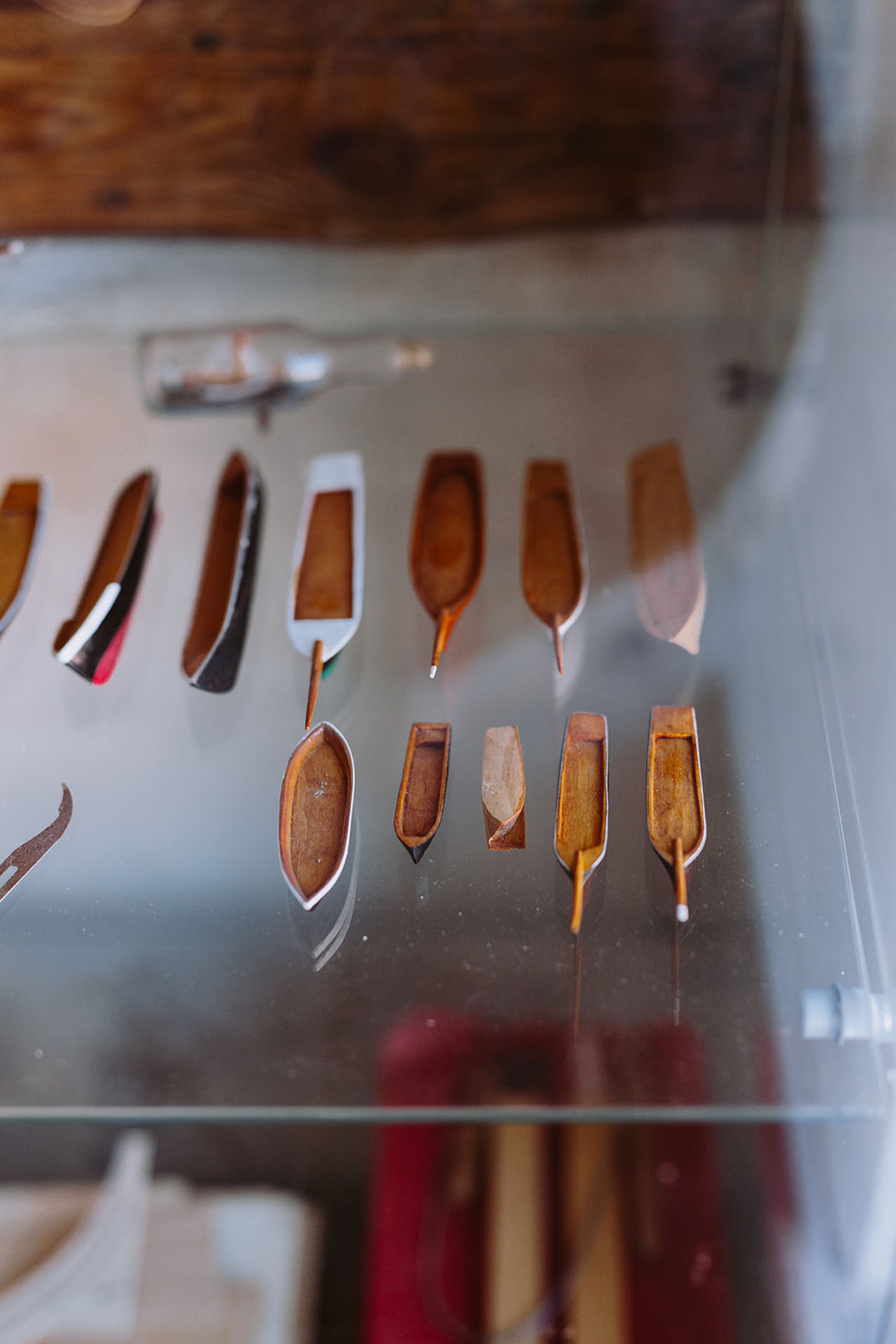
During World War II, however, Peter ran out of bottles, so instead he built ship models in cigar boxes. Several of these can be seen in the collection in Ærøskøbing.

The sailor Peter
Peter Jacobsen (Bottle-Peter) was born in Kalundborg on 29 September 1873. He lost his mother at the age of 8, and his father was left alone with two young children. His father was a lighthouse keeper at Gisseløre Lighthouse and also earned a living as a fisherman. From an early age, Peter developed a close connection to the sea and preferred going herring fishing with his father rather than attending school.
After finishing his schooling years, Peter became an apprentice at Kalundborg Iron Foundry & Machine Factory, but he only stayed there for a short time. Unfortunately, Peter’s father died at an early age, and after his father’s death, Peter went to sea at the age of 16 in 1889, where he found work. He first sailed on a Thurø schooner, and over the next 7–8 years he served on Norwegian sailing ships.
It was on board one of these Norwegian sailing ships that Peter met a Finnish sailor who taught him the old seafaring craft of building a ship inside a bottle. This passion stayed with Peter for the rest of his life. Over the following 70 years, Bottle-Peter (1873–1960) managed to build more than 1700 bottle ships and 50 large model ships.
The Seven Seas
In 1898, Peter returned to Denmark. He went ashore and trained as a cook at the hotel “Kongen af Danmark” in Copenhagen. After completing his apprenticeship, he went back to sea as a cook and later as a steward. He sailed with sailing ships of many different nations across the seven seas, and wherever he went, he pursued his hobby of making bottle ships.
In England, he met May, and they were married in 1903. After their wedding Peter stopped going on long voyages, and the couple first lived in England, then Germany, and later returned to England.
After World War I, the family moved to Grenå. Peter worked in various jobs, including as a fisherman, cook, and laborer. He built a small house where he exhibited his bottle ships.
Over time, the collection became well known, and Peter traveled to different towns to exhibit his bottle ships. He received several offers to buy the collection, but he wished instead to donate his bottle ships to a museum or a town that would provide him and his wife with a lifetime residence free of charge.
The collection comes to Ærøskøbing
In 1941, Peter got in touch with the Tourist Association for Ærøskøbing and Surroundings, which referred him to the municipality. An agreement was soon reached, and in 1942 Flaske-Peter and May were able to move into the old poorhouse on Smedegade.
On 22 April 1943, the exhibition officially opened. At the age of 70, Peter’s great wish of having his collection placed in a museum had finally come true.
In 1960, Peter passed away at the age of 86. He is buried at Ærøskøbing cemetery. In 1946, with the help of a master mason, Peter had a grave cross made featuring seven bottle ships symbolizing the seven seas he sailed as a young man. It was his wish for it to stand at his gravesite, but today the grave cross is on display at the museum.
Part of Museum Sydfyn
The bottle ships and the other exhibited objects have for many years been part of Ærø Museum’s collection. In 2015, the Association Bottle Peter’s Memorial Room took over the buildings at Smedegade 22. Over the following 10 years, the association made a tremendous effort to preserve the museum and, just as importantly, restored the iconic yellow building.
In 2025, the Association Bottle Peter’s Memorial Room transferred the buildings and the operation of the museum at Smedegade to Museum Sydfyn.